The peace treaty had already been signed. Nobody on the Chesapeake knew it. So when a British raiding boat came back for more of Moses Geoghegan’s sheep, the Bay froze around it, and a party of Dorchester County farmers walked out across the ice to collect.
The short version
- In February 1815 a raiding boat from the British warship HMS Dauntless stole seven sheep from Moses Geoghegan’s farm on James Island, Dorchester County, and promised to come back. When it did, the ice trapped it at the mouth of the Little Choptank River.
- On February 7, Private Joseph Stewart led about twenty local men across the broken ice to a ridge of piled-up ice slabs. From behind it they fired on the boat for about two hours until all twenty people aboard surrendered.
- It was the last fight of the War of 1812 on the Chesapeake, and it came six weeks after the peace treaty had been signed in Belgium.
Jump to: At a glance · Where it happened · How it happened · Weapons · Strange facts · Why it’s forgotten · Sources
The Battle at a Glance
| Date | February 7, 1815 (the sheep raid that started it was on the night of February 5) |
| Place | On the ice off James’s Point, James Island, just inside the mouth of the Little Choptank River, near Taylors Island (Dorchester County, Maryland) |
| Era | War of 1812 — after the Treaty of Ghent was signed, before the news arrived |
| Sides | Dorchester County militia and local volunteers vs. a tender from the Royal Navy sloop HMS Dauntless |
| Leaders | Private Joseph Fookes Stewart, 48th Maryland Militia, vs. Lieutenant Matthew Phibbs, Royal Navy |
| Strength | Americans: about 20, by Stewart’s own list (42 names were later paid prize money). British: 20 aboard by Phibbs’s count: a lieutenant, a midshipman, 13 seamen, 3 Royal Marines, a Black man and a Black woman. Armed with a 12-pounder carronade, a swivel gun, 17 muskets and 6 pistols |
| Result | American victory. Everyone aboard was taken prisoner. One British sailor was shot through the neck in the first volley |
Dec 24, 1814
Peace treaty signed in Ghent, Belgium
Feb 7, 1815
The fight at the Ice Mound off James Island
Feb 20, 1815
The Dauntless finally hears of peace — and of her lost boat
The Lay of the Land — and the Ice
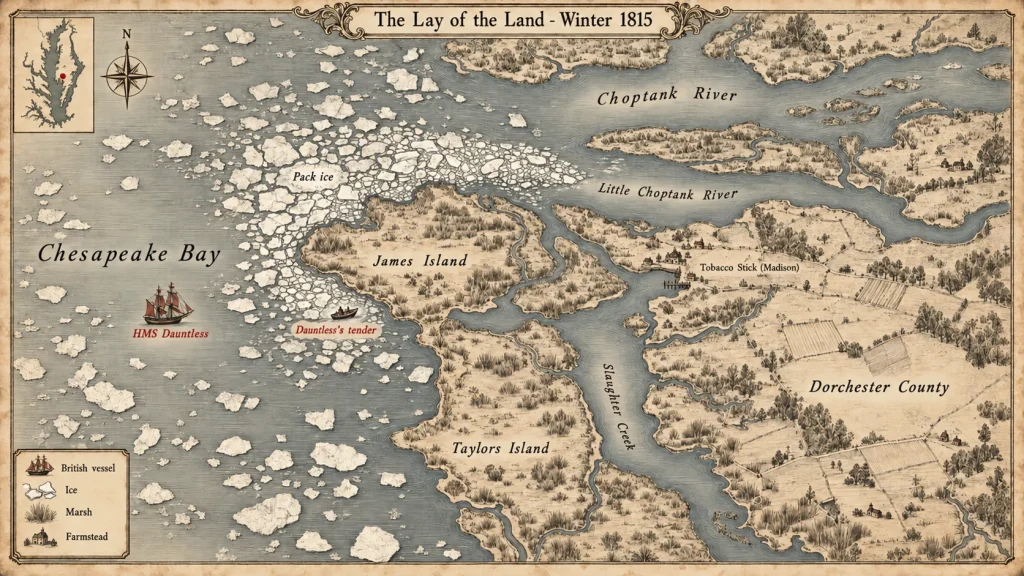
Dorchester County is Maryland’s low country: a maze of marsh, tidal creeks and flat farm islands where the Choptank and Little Choptank rivers empty into the Chesapeake Bay. Taylors Island sits about sixteen miles southwest of Cambridge, cut off from the mainland by Slaughter Creek. Just to its north lay James Island, a farm island of well over a thousand acres in those days, with James’s Point looking out over the mouth of the Little Choptank.
Families named Geoghegan, Travers, Tolly and Simmons, names that turn up again on the battle’s roll, lived on and around these islands. A little village on the mainland across Slaughter Creek went by the wonderful name of Tobacco Stick. Today it’s called Madison.
Normally the Bay was the Royal Navy’s highway. But February 1815 brought a hard freeze. Sheets of ice froze to the shore, big “cakes” of ice drifted in from the open Bay, and the tide piled loose slabs into ridges. That last detail is the whole story.
The Last Fight on the Chesapeake
I. A Raider Named Phibbs
By 1815 the British had raided the Chesapeake for two years, burning towns, hitting Kent Island and St. Michaels, and in 1814 landing the army that burned Washington and then failed at Baltimore. HMS Dauntless, a sloop of war, arrived from Halifax on October 30, 1814. Her logbook shows a busy winter: capturing American trading ships, gathering food for the fleet, and taking aboard 71 Black refugees who had escaped slavery and were sent on to Bermuda.
The ship’s boats were run by Matthew Phibbs, a young officer only temporarily promoted from midshipman to lieutenant. In January 1815 alone his boat crews captured the Caroline of Oxford, with 200 gallons of beer that was served to the crew a pint a day, burned the Charles of Baltimore, took the Nimrod with a cargo of herring, and seized schooners carrying whiskey. Livestock from shore farms was fair game too.
II. Seven Sheep
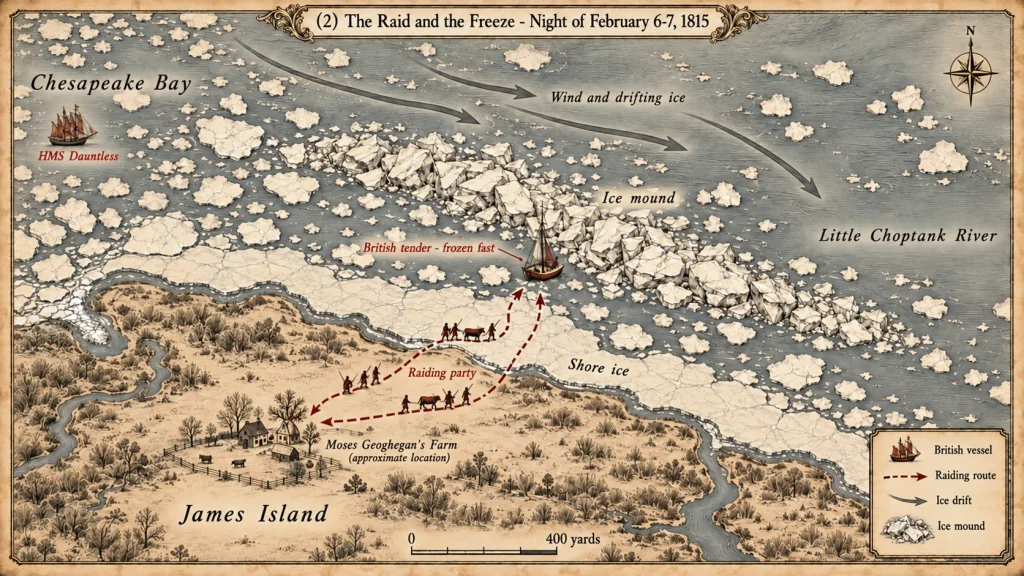
On Sunday evening, February 5, 1815, a British schooner — a tender, or small armed helper vessel, from the Dauntless — came in close to James Island. That night a boat went ashore and took seven sheep from Moses Geoghegan’s farm. As they left, the raiders let it be known they would be back the next day.
They meant it. On Monday the tender returned to its ship, then came back toward the island in the evening. The Dauntless’s log notes three schooners spotted in the Little Choptank, and boats sent in after dark. But this time the island was ready. The militia colonel had been warned, and Joseph Stewart, a 36-year-old planter and shipyard owner serving as a private, hurried down to James’s Point with a supply of musket cartridges. He found about twenty people waiting there: men, boys and a few Black people.
At dusk a British boat tried to land, but the ice stopped it. The raiders rowed along the edge, fired a musket or two as a signal to the tender, and went back. The watchers drifted off to Levin Saunders’ house about a mile away, leaving a few men on lookout through a night of hard frost.
III. Frozen Fast
At sunrise on Tuesday, February 7, the news came in: the tender was stuck just inside the mouth of the Little Choptank. A big cake of ice had drifted in from the Bay and was pinning it against the ice frozen to the shore, about 400 yards out. Out in the Bay, the Dauntless herself was frozen fast by 7 o’clock that morning.
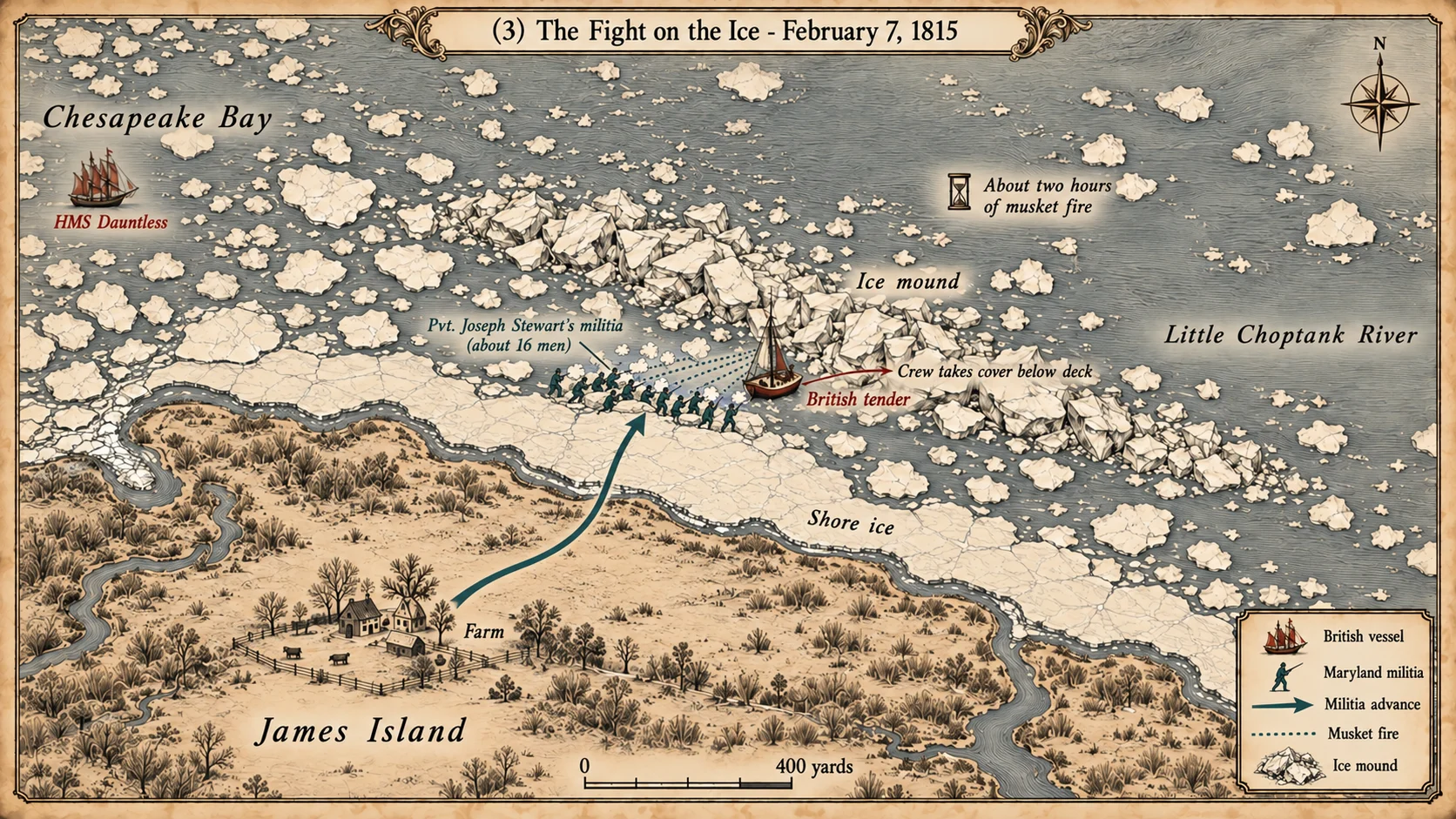
Most of the men at Saunders’ house decided they couldn’t take an armed vessel without a cannon, sent to Cambridge for one, and went home. Stewart and a handful of others went down to the Point anyway. There they spotted something useful: a heap of ice slabs about 150 yards from the tender, piled up by the tide into what Stewart called “a good breastwork.”
IV. The Fight on the Ice
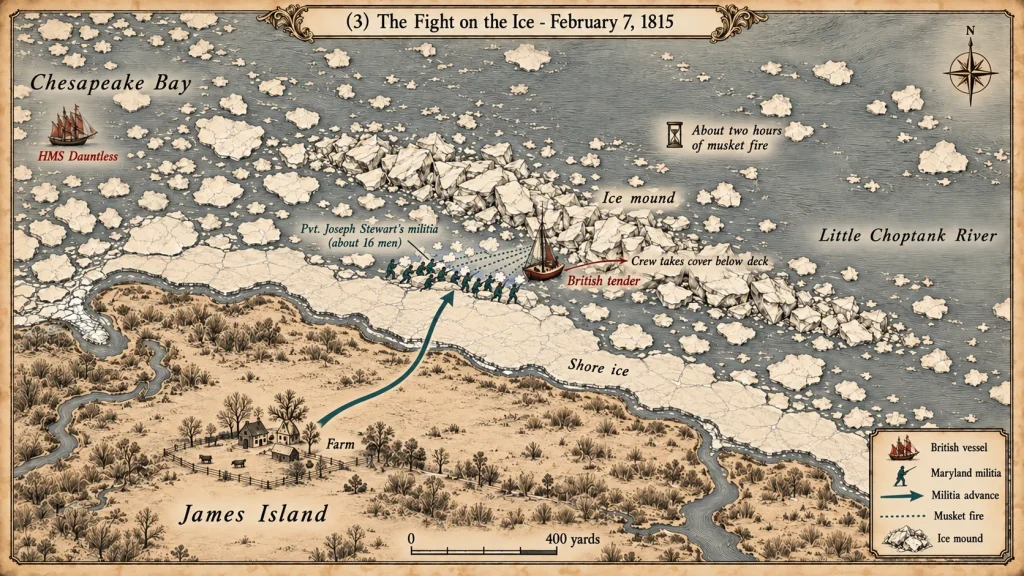
Getting there was the dangerous part. The ice had thawed, cracked and refrozen, so Stewart’s party had to jump from one hard cake to the next to avoid the thin patches. They reached the ice mound just as the British were raising their anchor and loosening their sails to escape.
Only three British sailors were on deck when the Marylanders opened fire. One was shot through the neck and fell, and the other two dove below. The crew then fired muskets back out of the hold. Stewart’s men lay behind the ice, watching for anyone who showed himself and firing at a strip of canvas along the rail where they suspected men were hiding. The British carronade was useless: it couldn’t be aimed from a boat locked in ice at men tucked behind a frozen wall. It went on like that for about two hours.
V. Surrender
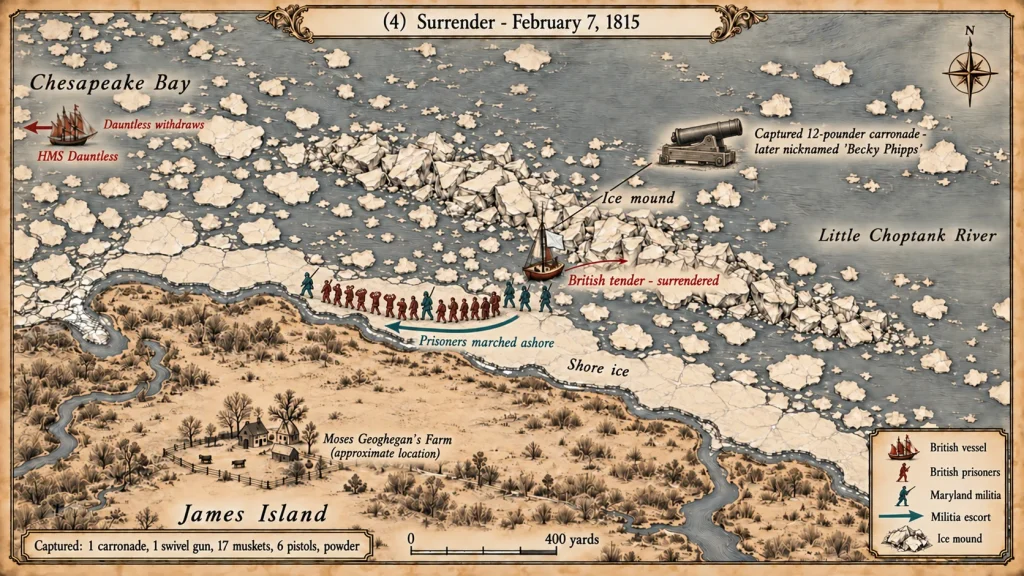
Then, all at once, the whole British party came up on deck shouting for quarter and waving their handkerchiefs. Stewart’s men climbed up on top of their ice wall. Stewart ordered the crew to leave their weapons and come over in their own boat, which they did through an opening in the ice. They were taken prisoner on the ice and marched ashore.
The haul was a 12-pounder carronade, a swivel gun, seventeen muskets, six pistols and plenty of powder and shot, along with twenty prisoners. Three days later Stewart handed them over to the deputy marshal, and on February 12 Lieutenant Phibbs signed a note in Easton confirming his surrender. The Dauntless didn’t learn what had happened until February 20, when a boat brought news of the peace and of her captured crew in the same breath. She left the Chesapeake for good a week later.
Carronades Against Cold Feet
| Stewart’s party | The Dauntless’s tender |
|---|---|
| About 20 militiamen and neighbors: farmers, watermen and at least one Black man | 20 aboard: an officer, a midshipman, 13 seamen, 3 Royal Marines, a Black man and a Black woman |
| Muskets and the cartridges Stewart carried down to the Point | One 12-pounder carronade and one swivel gun |
| No cannon (one was sent for, but the fight was over first) | 17 muskets and 6 pistols, fired from the hold |
| A ridge of heaped ice about 150 yards from the boat | A wooden boat pinned between two sheets of ice |
| Freedom to move and pick their moment | No way to move, and no way to aim the big gun |
On paper the British should have won this. A carronade loaded with grapeshot could sweep a beach clear. But a gun is only as good as the vessel that can point it. Frozen in place, the tender became a little wooden fort with its one big gun facing the wrong way, and the ice handed the Marylanders exactly what infantry wants: cover, patience, and a target that can’t leave.
“A good breastwork from whence the Tender might be attacked.”
Joseph Stewart, describing the ice mound, February 13, 1815
Strange Facts Nobody Told You
- The war was already over, sort of. The treaty was signed on December 24, 1814. The copy didn’t reach New York until February 11, four days after the fight, and the war officially ended on February 17. Stewart’s account of the battle ran in the Annapolis Maryland Gazette on February 23, six days after the peace became official.
- It all started with seven sheep. If the raiders hadn’t promised Moses Geoghegan’s farm a return visit, nobody would have been watching the shore. Moses Geoghegan then turned up on Stewart’s list of the men who fought.
- Promoted while a prisoner. Back in England, Phibbs’s promotion to lieutenant was made permanent on February 9, 1815, two days after he surrendered on the ice.
- The Navy blamed the weather. Phibbs’s service record says he was captured “by the Chesapeake being frozen up” and the vessel catching fire. The Marylanders saw it a little differently.
- Who was “Becky”? The cannon is named for the Black woman taken aboard the tender, remembered as Becca, and for Lieutenant Phibbs. Who she was is murky. One modern account says the raiders had carried off two house servants from local farms. The marshal’s list names the Black man as Abraham Travers, a local surname, and the ship’s books list a “black refugee from Virginia.” The records don’t settle it.
- From 20 heroes to 42. In 1816 Congress awarded Stewart and his comrades $1,800. By the time the money was paid out, the list had grown from about 20 names to 42, and Stewart’s own share came to just $42.90.
- One boat, or two? Stewart describes an armed schooner. The Dauntless’s log says she lost her longboat and her jolly boat. Some modern write-ups even claim the Dauntless herself was captured. She wasn’t, though she was frozen in too.
- A long shot. Even from the ice mound, the militia were firing at about 150 yards, roughly twice the distance a smoothbore musket could reliably hit a man. Two hours of patience made up the difference.
- “Inaccurate in the extreme.” That’s how the 1975 historian described the old plaque on the cannon. It gave the year as 1814, short-counted the crew, and promoted Private Stewart to captain.
- Where was it, exactly? Stewart says the Little Choptank, off James’s Point. One tourism write-up puts the tender in Slaughter Creek, and the state chronology files the fight under Taylors Island.
- The battlefield is melting away. James Island covered about 1,350 acres in the 1660s. By the late 1990s erosion had cut it to roughly 550.
Why History Forgot the Battle of the Ice Mound
Everything about it was too small and too late. One boat, a few dozen people, no famous names, and it was fought after the treaty was signed and only ten days before the war officially ended. National histories of 1815 jump straight from New Orleans to peace, and a frozen skirmish over seven sheep never stood a chance. Even the 1975 historian who pieced it together noted that the full story had never been told before.
Locally it never went away. The captured carronade was kept for years at Tobacco Stick, now Madison. Today it stands beside the state’s “Battle of the Ice Mound” marker on Route 16, just west of the Slaughter Creek bridge on Taylors Island. According to a Taylors Island history group, it was damaged in an accident during a 1912 celebration and rededicated in 1999. If you’re ever driving to Taylors Island, you pass right by the last battlefield of the War of 1812 on the Chesapeake.
Keep exploring
Browse War of 1812 to follow the story, or take a detour into Weird History.
Sources & Further Reading
- “The Battle of the Ice Mound, February 7, 1815,” by Robert G. Stewart — Maryland Historical Magazine, vol. 70, no. 4 (Winter 1975), pp. 372–378. Includes Joseph Stewart’s eyewitness account, the Dauntless logbook, the prisoner lists and the Acts of Congress
- Battle of the Ice Mound historical marker — The Historical Marker Database (marker text and the cannon’s location)
- Seven Sheep, a Cook and Karma — Dorchester County Tourism
- Battle of the Ice Mound — Grace Foundation of Taylors Island (local history and the cannon’s later story)
- Battle of the Ice Mound, February 7, 1815 – Dorchester County — Maryland in the War of 1812
- HMS Dauntless (1808) — Wikipedia
- Fun Fact: The Battle of the Ice Mound — Maryland Association of Counties
- The Battle of the Ice Mound — WYPR, “Your Maryland”
- War’s End — National Park Service (treaty dates)
- Senate Approves Treaty of Ghent — United States Senate
- Maryland’s Eastern Shore — National Park Service, Star-Spangled Banner National Historic Trail
- Dorchester County chronology — Maryland Manual On-Line, Maryland State Archives
- Most of what now exists of eroding James Island is memories — Bay Journal
- By the Byways: Cambridge to Taylors Island — Talbot Spy
A note from Voidexe
This story owes nearly everything to one source: Robert G. Stewart’s essay “The Battle of the Ice Mound, February 7, 1815,” in the Maryland Historical Magazine (Winter 1975, pages 372–378). It reprints Joseph Stewart’s own eyewitness account, the Dauntless logbook, the names of the men who crossed the ice, and the names of the prisoners they took. That’s where Moses Geoghegan’s seven sheep come from.
The Maryland State Archives has the whole magazine issue online for free. If this battle grabbed you, read the original: Maryland Historical Magazine, Vol. 70, No. 4 (PDF, about 8 MB). Thank you to the archivists who keep records like this free for everyone.
Leave a Reply