Thirteen months after Yorktown, on the very day peace terms were being signed in Paris, two little fleets of rowing barges met in the marshes off Smith Island. One stray spark later, it became one of the bloodiest few minutes of the whole war on the water.
The short version
- On November 30, 1782, Maryland’s little state navy, with Virginia volunteers aboard, attacked six Loyalist raiding barges in Kedges Strait, off Smith Island in the Chesapeake Bay.
- Most of the Maryland barges turned back. The flagship Protector fought on alone — until her own gunpowder exploded and the enemy swarmed aboard.
- The war was basically over. Britain and America signed their preliminary peace terms in Paris that same day, and nobody on the Bay had any idea.
Jump to: At a glance · Where it happened · How it happened · Weapons · Strange facts · Why it’s forgotten · Sources
The Battle at a Glance
| Date | November 30, 1782 |
| Place | Kedges Strait, between Smith Island and South Marsh Island, Chesapeake Bay (Somerset County, Maryland) |
| Era | American Revolution — after Yorktown |
| Sides | Maryland state barges and Virginia volunteers vs. Loyalist “refugee” barges sailing under the British flag |
| Leaders | Commodore Zedekiah Whaley and Lt. Col. John Cropper vs. Commodore John Kidd |
| Strength | Maryland: four or five barges, with 65 men aboard the Protector. Loyalists: six barges (crew numbers unknown) |
| Result | Loyalist victory. The Protector was captured and Whaley was killed |
Oct 1781
Yorktown — the big land war ends
Nov 28, 1782
Whaley asks Onancock for volunteers
Nov 30, 1782
The barge fight in Kedges Strait — the same day as the Paris peace terms
The Lay of the Water
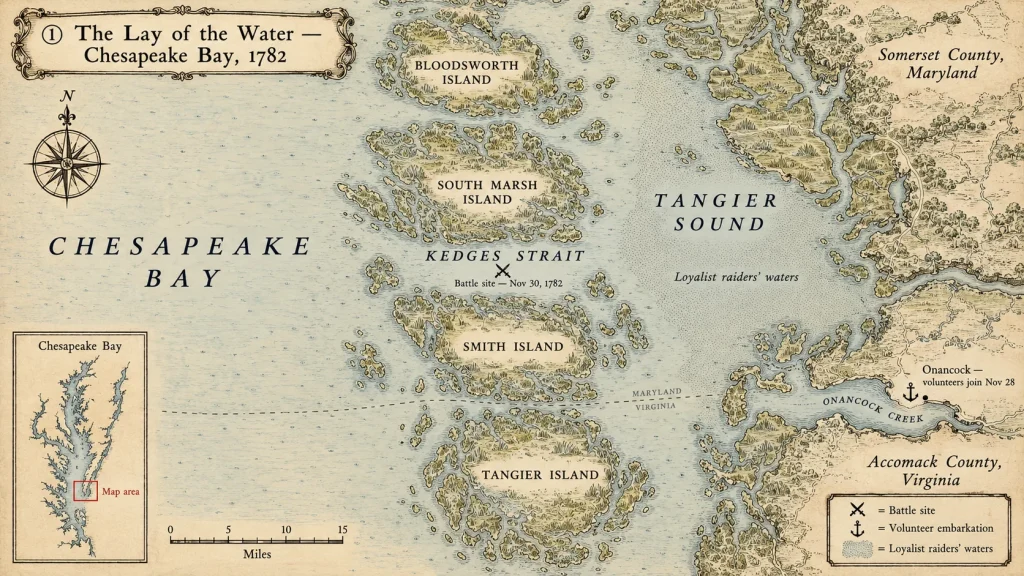
Kedges Strait is a channel of open water in the middle of the Chesapeake Bay. Smith Island lies to the south and South Marsh Island to the north, and the strait links the wide main Bay with Tangier Sound, the sheltered water behind the islands. Today the Solomons Lump lighthouse marks the general area of the fight.
This is a world of low marsh islands that barely rise above the tide, shallow flats and winding creeks. Big ocean-going warships kept to the deep channels. In here, the barge was king: a long, low, open boat with a mast or two and rows of oars, able to slide over the shallows and duck into creeks where nothing bigger could follow.
Across Tangier Sound lies the Eastern Shore — Maryland’s Somerset County, and farther south Virginia’s Accomack County, where the town of Onancock sits up a winding creek. In 1782 these were farming and fishing communities, and the water that fed them was also the road the raiders used to reach them.
The Battle of the Barges
I. A War That Wouldn’t End
When the British army surrendered at Yorktown in October 1781, the big battles were over. Out on the Chesapeake, the war carried on. Armed barges crewed by Loyalists — Americans who had sided with the king — kept raiding farms, plantations and trading boats. Maryland’s government blamed Tories and “refugees” for most of the attacks, and said their base was among the islands of Tangier Sound.
Their leader was a Loyalist commodore named John Kidd (no known relation to the famous pirate), who used Hog Island as a hideout for his plunder. His crews were a mix of Loyalists, British sailors and men who had escaped slavery, for whom fighting under the British flag meant a chance at freedom.
In the summer of 1782 Maryland struck back with a barge fleet of its own. It was led by Captain Zedekiah Whaley, a Somerset County man, and his orders were plain: “protect our Bay Trade.” The fleet included the Protector, the Defence, the Fearnought and the Terrible, which sounds fearsome on paper.
II. Volunteers from Onancock
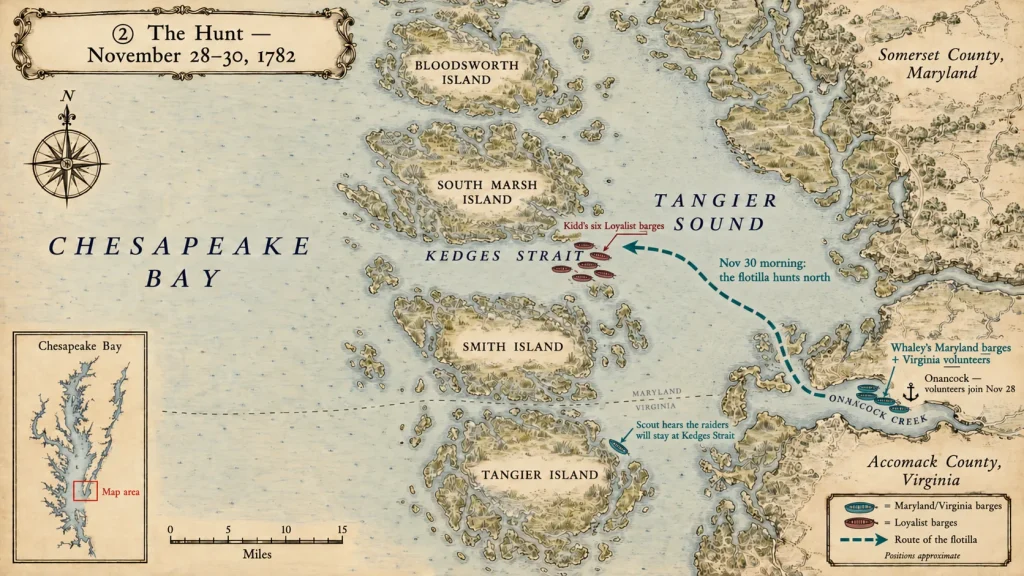
On November 28, Whaley wrote to Colonel John Cropper, the militia commander of Accomack County, Virginia. Kidd’s barges were off Onancock, he said, and he meant to attack them, but he needed more men. Cropper didn’t just send help. He came himself, with twenty-five Accomack militiamen.
Several officers crowded aboard the flagship Protector with him, among them Major Smith Snead, Captain William Snead and Captain Thomas Parker, a hard-bitten veteran whom the local Tories called “Hangman Tom.” According to one modern account, an American scout boat learned from a Tangier Island man named Crockett that the enemy planned to stay at Kedges Strait. The hunt was on.
III. Three Hundred Yards
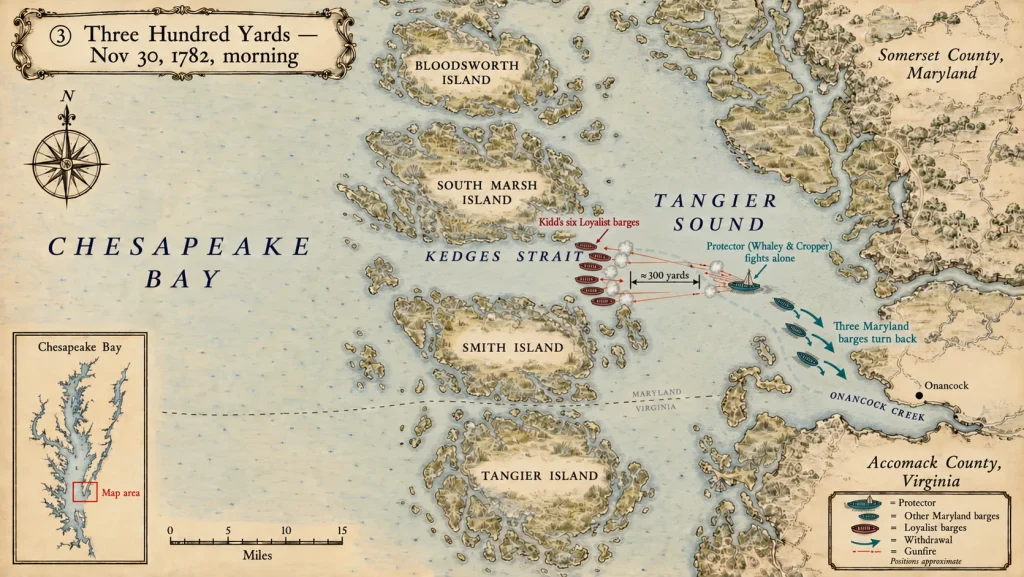
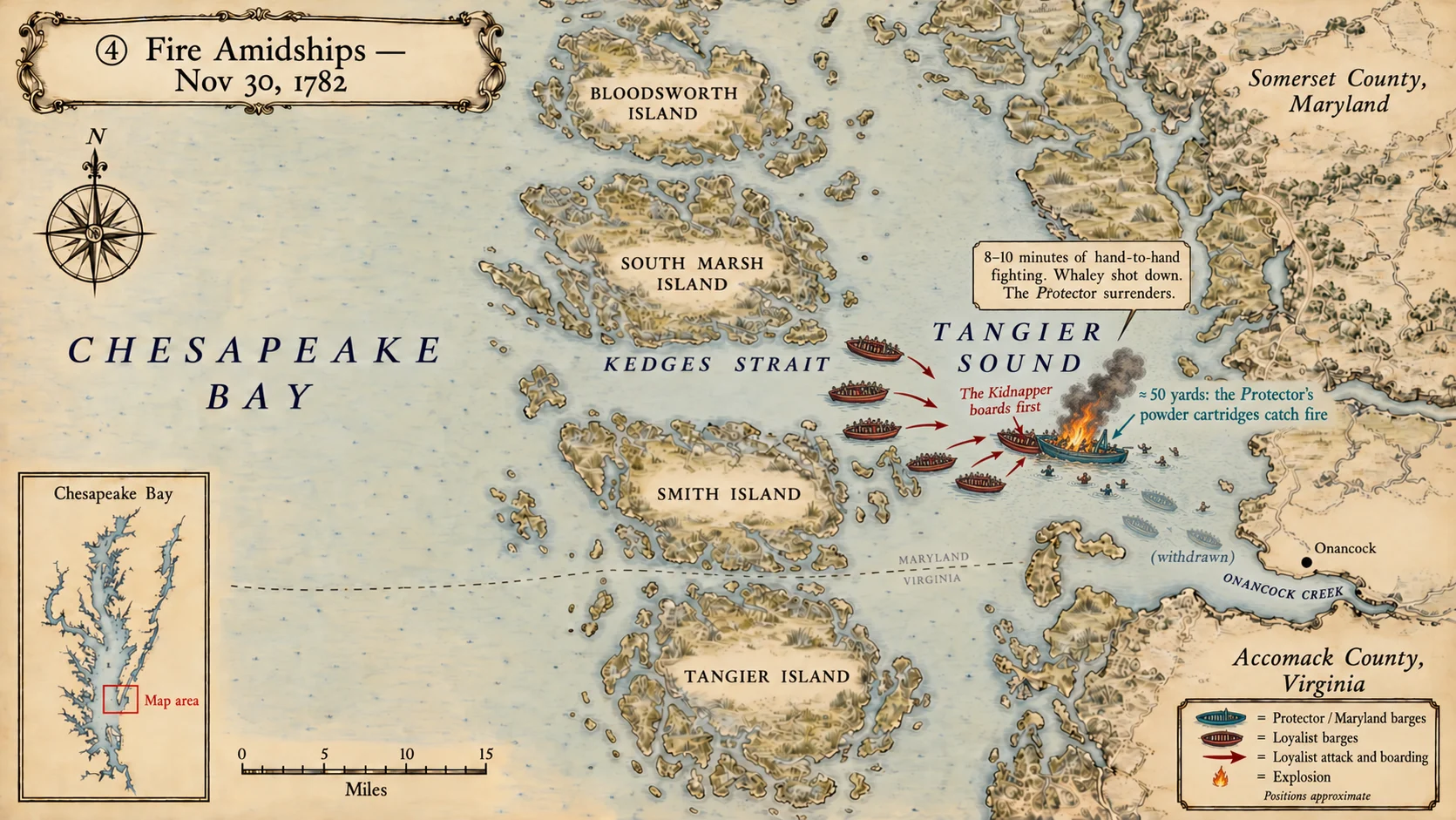
On the morning of November 30, at the head of Kedges Strait, the Maryland flotilla found Kidd’s six barges, and the Loyalists turned to fight. When the two fleets were about three hundred yards apart and the shooting became serious, something went badly wrong. In Cropper’s words, “our barges all run away except the Commodore’s.”
He called it “dastardly conduct.” Now the Protector was alone, taking fire from all six enemy barges at once, and she answered gun for gun as the range closed.
IV. Fire Amidships
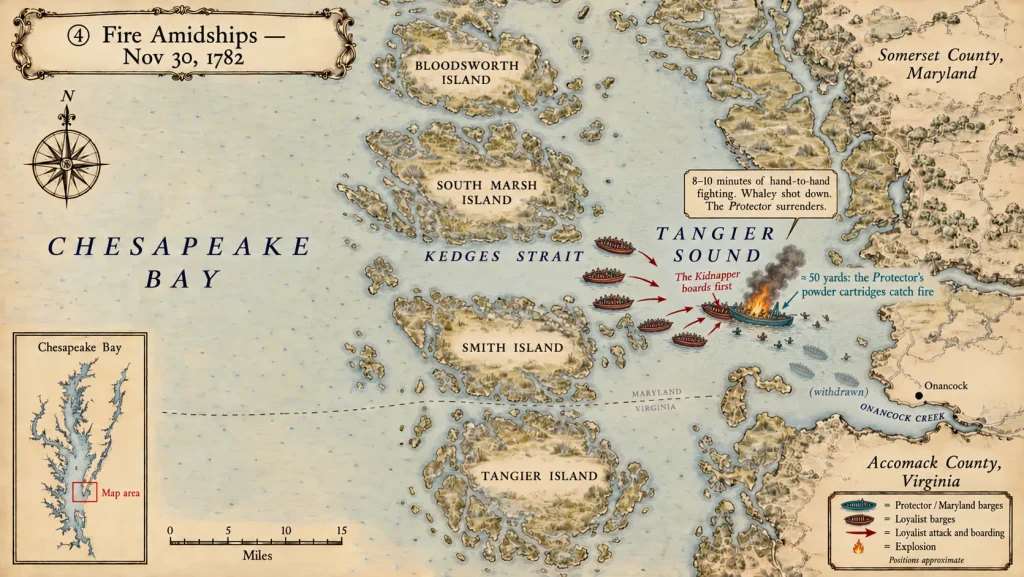
The enemy had come to within about fifty yards when disaster struck. The Protector carried short eighteen-pounders: stubby cannon that fired an eighteen-pound iron ball. Their gunpowder came in cartridges, cloth or paper bags of powder, and in the middle of the barge those cartridges caught fire.
The blast burned three or four men to death. Five or six more, their clothes on fire, leaped into the Bay, and several others, sure the whole barge was about to blow up, jumped over the side and swam for their lives. Kidd’s men later admitted to Cropper that they had almost decided to retreat. Instead, seeing the smoke, they pushed in “with redoubled fury.”
V. Pikes, Cutlasses and Cold Shot
The first enemy barge to come alongside was named, of all things, the Kidnapper. What followed was eight or ten minutes of brutal hand-to-hand fighting. Defenders threw cannonballs by hand (“cold shot”) and swung iron stanchions, the posts that held up the barge’s rails. Commodore Whaley was shot down just before the enemy boarded. Cropper remembered him as “a cool, intrepid, gallant officer.”
With nearly every officer killed or wounded, the Protector struck her colors. Of the 65 men aboard, 25 were killed or drowned and 29 were wounded. Only 11 came out unhurt, mostly men who had jumped into the water to escape the explosion. They had not gone down easily: Kidd was wounded, one of his captains killed and another wounded, and fifteen of the Kidnapper’s crew killed or wounded.
VI. The Morning After
Cropper was in a bad way, with a cutlass wound to the head and pike wounds to the face and thigh. Even so, he made a deal with Kidd. The Americans would take Kidd’s wounded ashore and nurse them at public expense, and in return Kidd would release every American prisoner on parole, wounded or not. Kidd kept his word, writing to Cropper three days later: “Trusting to your Honor, We have sent all the Prisoners.”
Whaley was buried with military honors beside Onancock Creek, on the farm later known as Scott Hall. By the 1890s the grave was unmarked and almost forgotten. Back in Annapolis, Maryland’s Council suspended Captain Robert Dashiell of the Terrible and Lieutenant Zadock Botfield of the Fearnought for “highly unbecoming and improper Conduct” in the battle. Botfield was later reinstated, and the Council put off a decision on Dashiell.
Eighteen-Pounders and Boarding Pikes
| Maryland and Virginia | Kidd’s Loyalists |
|---|---|
| Oared barges with sails: Protector, Defence, Fearnought, Terrible (one account adds a Virginia volunteer barge, the Victory) | Six barges, about 65 feet long, driven by sail and oars |
| Short eighteen-pounder cannon | Cannon, including at least one four-pounder (its rammer comes back into the story later) |
| Muskets, pikes and cutlasses, plus thrown “cold shot” and iron stanchions | Muskets, boarding pikes and cutlasses |
| State sailors and marines, plus Accomack volunteers (65 aboard the Protector) | Loyalists, British sailors and men who had escaped slavery |
| Heavy guns that could smash a barge at close range | Numbers, once the rest of the Maryland fleet pulled back |
A barge fight came down to three things: closing the distance, keeping your powder safe, and having enough men when the boats crashed together. The Protector had the heaviest guns on the water. But open boats carried their powder out in the open, a single spark could turn a gun deck into a bonfire, and once the boarders came over the side, six barges full of men beat one.
“One continual shower of musket balls, boarding pikes, cutlasses, cold shot…”
Col. John Cropper, describing the boarding fight, December 1782
Strange Facts Nobody Told You
- Peace, the same day. Britain and America signed their preliminary articles of peace in Paris on November 30, 1782, the same day as the barge fight. News took weeks to cross the Atlantic, so the men in Kedges Strait were fighting a war that was already ending.
- A barge called the Kidnapper. Of all the names to see coming alongside, that was the barge that boarded the Protector first.
- Saved by the other side. According to a family memoir published in 1892, two of the first boarders were a man who had once been enslaved by Cropper’s father and had escaped to join Kidd’s crew, and an Irish soldier whom Cropper had once captured and treated kindly. When they recognized the wounded colonel, they turned around, swords in hand, and held back their own shipmates until Kidd, who had been knocked senseless, came to and restored order.
- Hit twice in the same spot. After the surrender, a wounded Englishman lying nearby grabbed the rammer from a four-pound cannon and clubbed Cropper on the head, right where the cutlass had already cut him.
- No sympathy at home. When Cropper got home to Onancock, his wife reportedly told him he deserved it, for “a Continental officer” to leave his family “to fight sailors on the water.” He called her his “keen ground razor.”
- Name chaos. The commodore’s name appears as Whaley, Walley and Wally, and one printed copy of Cropper’s letter calls the battlefield “Cagey’s Straits.” Today the strait itself is spelled both Kedges and Kedge’s.
- Debate: the last sea battle of the Revolution? The fight is often called the last naval action of the war, but the Continental frigate Alliance fought a British ship in March 1783, and that clash has its own claim. Some modern write-ups also call Kidd’s force “Royal Navy” and mix up the casualty figures. Cropper’s own count, given above, comes from the man who was there.
Why History Forgot the Battle of the Barges
It was fought after the war was supposedly won, between small boats, with no famous general in sight, and it ended in a defeat with an embarrassing retreat attached. That isn’t a story anyone was eager to put in a schoolbook. The records are scattered too: Maryland Council minutes, Cropper’s battered letter, and a family memoir written more than a century later.
On the Eastern Shore it never quite vanished. Virginia put up a historical marker, the Maryland Maritime Archaeology Program has lectured on the battle, and the Sons of the American Revolution have run boat trips out to Kedges Strait to lay memorials over the water. Most of the country remembers Yorktown as the end of the Revolution. On the Chesapeake, the war went on for more than a year after it.
Keep exploring
Browse American Revolution to follow the story in order, or take a detour into Weird History.
Sources & Further Reading
- “Memoir of General John Cropper,” by Barton Haxall Wise — Collections of the Virginia Historical Society, vol. XI (1892), pp. 298–303, including Cropper’s letter of December 6, 1782, and Kidd’s letter of December 3
- Journal and Correspondence of the Council of Maryland, 1781–1784, p. 313 — Archives of Maryland, vol. 48 (report of the action, December 1782)
- Council of Maryland, p. 328 and p. 329 — suspension of and inquiry into Dashiell and Botfield
- Council of Maryland, p. 226 — Whaley’s orders and the barge captains, July 1782
- Archives of Maryland, vol. 48, preface — the Tangier Sound raids and the “Battle of the Barges”
- “340 years after Battle of Kedges Straits, SAR hosts boat ride to site” — Bay to Bay News
- Battle of the Barges (Battle of Kedges Strait) — History of the Marine Corps
- Battle of Kedges Strait — Wikipedia (see its references; note the casualty mix-up)
Leave a Reply