He is remembered for chasing a magical Fountain of Youth. The truth is stranger: Juan Ponce de León, the man who gave Florida its name, was beaten twice by the Calusa — a nation most Americans have never heard of — and the second time, it killed him.
The short version
- In 1513, Calusa war canoes drove Ponce de León’s three ships off the Florida coast after a fight that lasted from morning until night.
- In 1521 he came back to start a colony — and a Calusa arrow wounded him. He died in Cuba weeks later.
- The “Fountain of Youth” legend was attached to him after his death. His real goals were land, gold and a royal title.
Jump to: At a glance · Where it happened · Round One (1513) · Round Two (1521) · Weapons · Strange facts · Why history forgot them · Sources
The Battle at a Glance
| Dates | June 1513 (the canoe battle) and 1521 (the fatal landing) |
| Place | Charlotte Harbor and Pine Island Sound, southwest Florida |
| Era | Colonial America — the Spanish arrival, decades before Jamestown |
| Sides | Spanish expedition vs. the Calusa nation |
| Leaders | Juan Ponce de León; the Calusa paramount chief (his name is not recorded for 1513) |
| Strength | 1513: three Spanish ships vs. a Calusa fleet reported as about 80 canoes (some read it as 80 warriors). 1521: about 200 colonists in two ships |
| Result | Calusa victory both times. The first Spanish attempt to colonize Florida collapsed within days |
1513
Calusa canoes drive off Ponce’s ships
1521
A Calusa arrow ends his colony — and his life
Late 1700s
The Calusa vanish after two centuries of resistance
The Lay of the Land
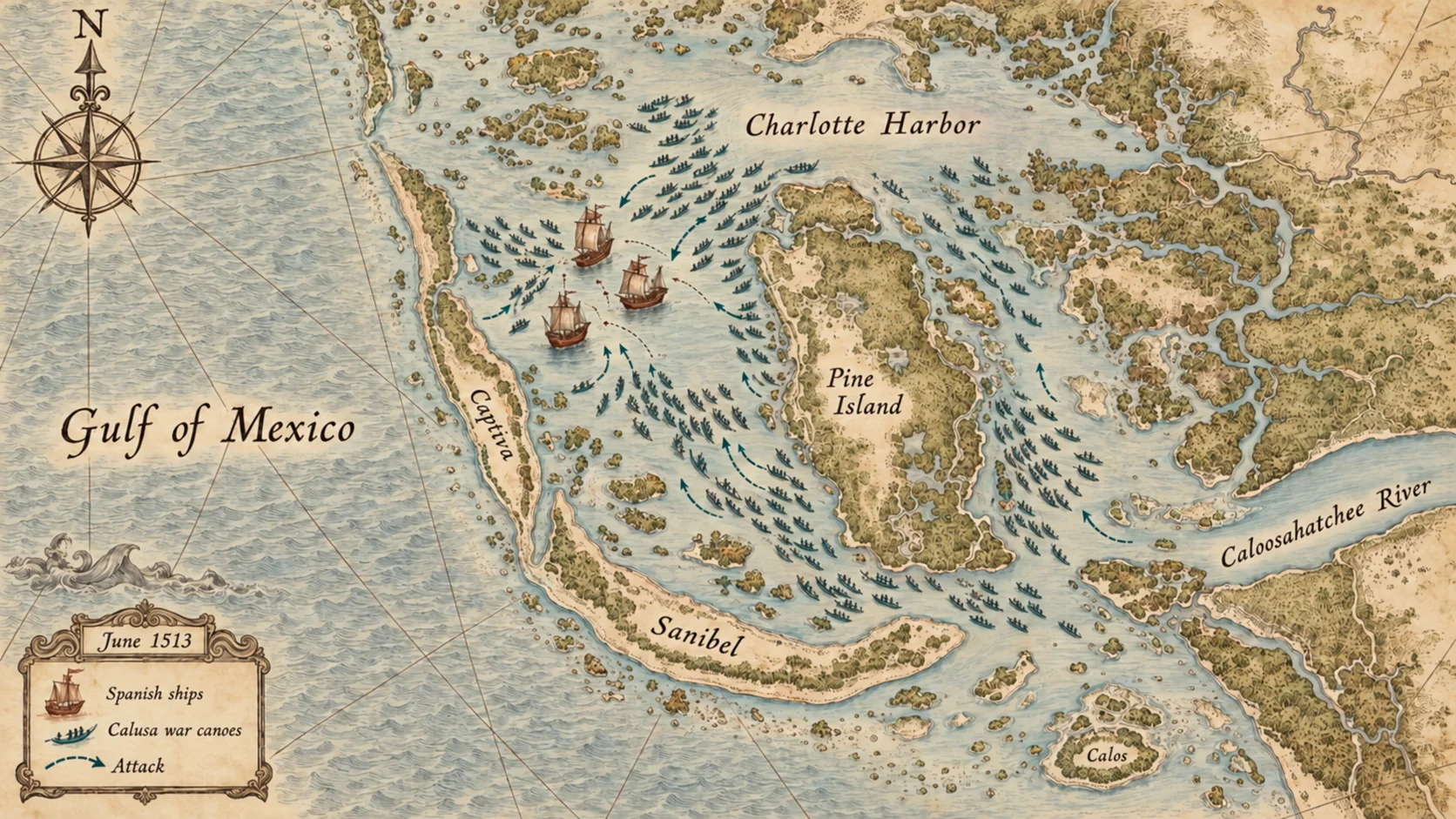
Forget open battlefields. The Calusa lived in a maze of water: shallow bays, river mouths, long barrier islands like Captiva and Sanibel, and thousands of mangrove islets whose tangled roots can hide a canoe a few yards away. Some of their islands were literally built by hand — towering mounds of shells raised over centuries. Their capital, Calos (most likely today’s Mound Key in Estero Bay), was laced with canoe canals, some reportedly stretching for miles.
With an estimated 4,000 to 10,000 people, the Calusa were the dominant power of south Florida. They didn’t farm; they harvested the sea, and their chief collected tribute from towns across the region. In other words, Ponce de León wasn’t sailing into empty wilderness. He was sailing into someone else’s kingdom.
Round One — The Canoe Battle of 1513
I. Sails on the Horizon
In March 1513, Ponce de León left Puerto Rico with three ships, hunting for a land called “Bimini” that he had royal permission to conquer. In early April he reached a coast he named La Florida — partly for the Easter season, Pascua Florida, partly for the flowers. After probing the Atlantic coast, he rounded the southern tip and sailed up the Gulf side, into Calusa waters around Charlotte Harbor.
The Calusa may already have known what Spanish ships meant. Slave raiders from the Caribbean had been seizing people from Florida’s coasts, and according to one account, at least one local man greeted the expedition in Spanish — a sign that Europeans had been there before, uninvited.
II. Day One — The Trading Trick
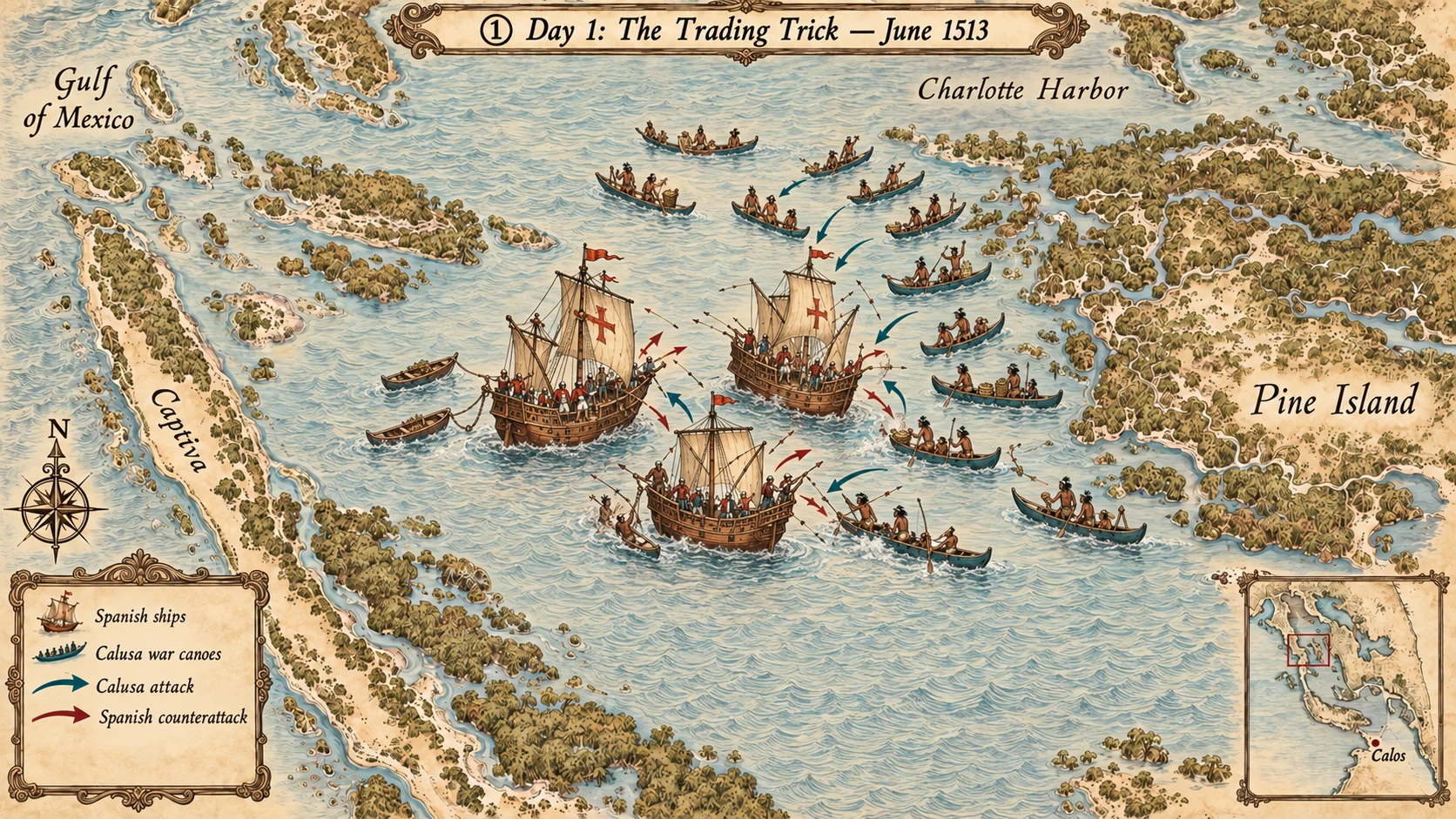
In early June, with the ships anchored inside the sound, around 20 canoes paddled out as if to trade. Then they attacked. The Spanish fought back, drove the canoes off, and captured a few of them along with several prisoners. Ponce then tried diplomacy, reportedly sending captives to the chief with a message of peace.
III. Day Two — The Great Canoe Attack
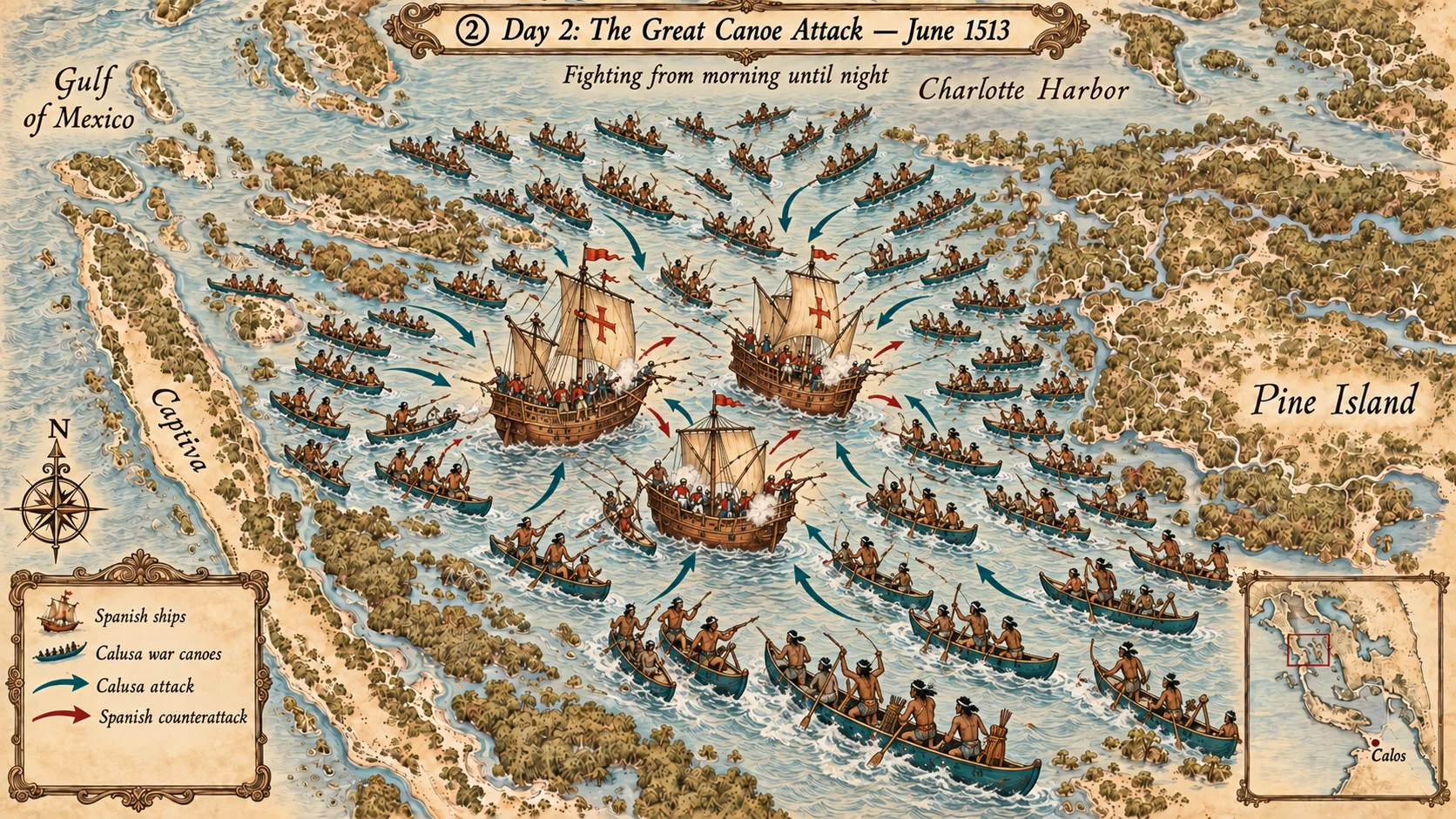
The chief’s answer came the next day — and it was not peace. A far larger force returned; the Spanish accounts are usually read as about 80 war canoes, though some historians interpret it as about 80 warriors. Either way, the fighting reportedly lasted from morning until night. Calusa archers with long bows poured arrows at the ships, while the Spanish answered with crossbows and a few early guns that were slow to reload and famously unreliable in sea air.
IV. Retreat to the Gulf
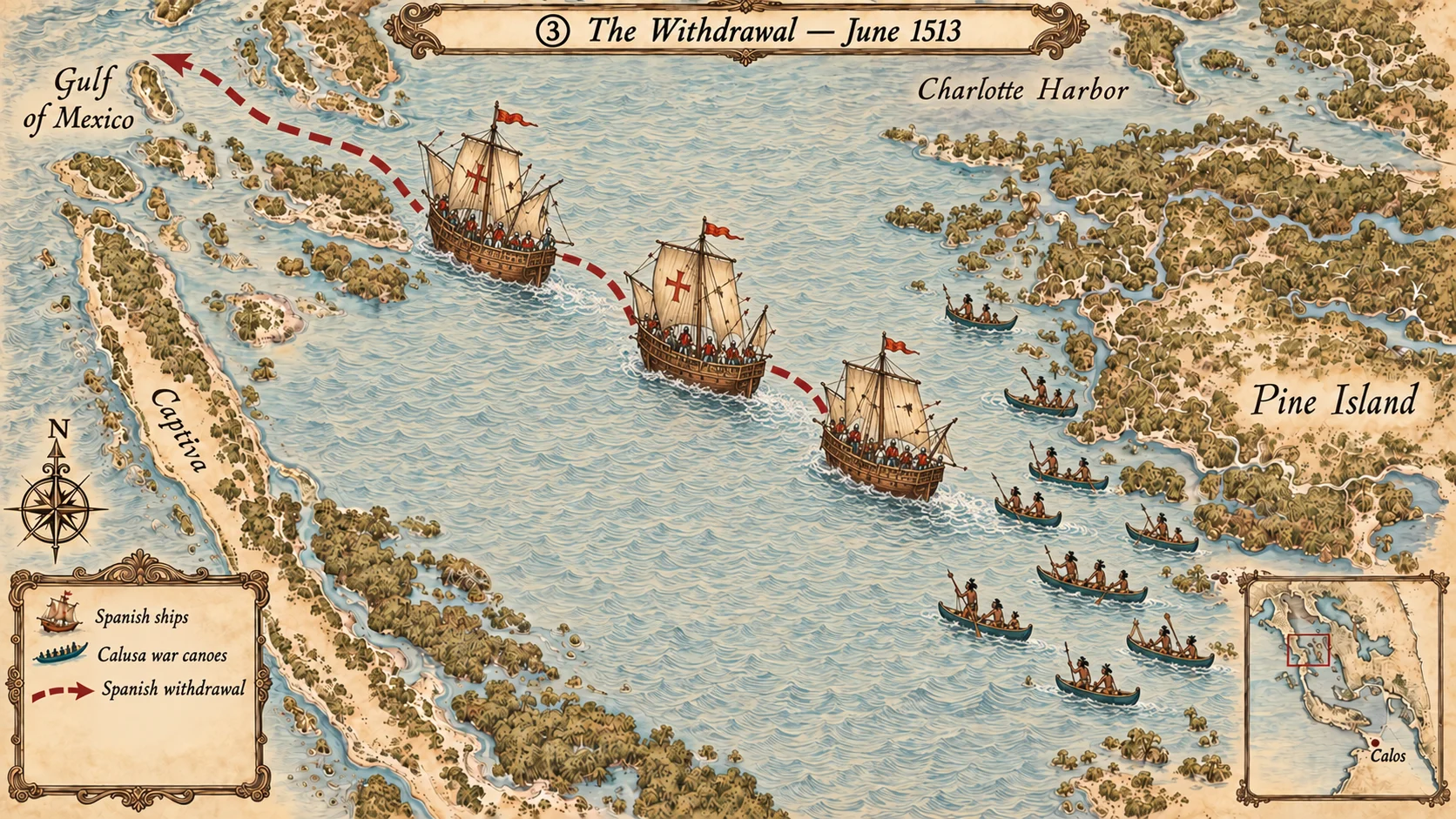
The Spanish could not land, could not win, and could not stay. Ponce gave up on the Calusa coast and sailed away. Round 1 went to the Calusa — and Ponce de León came away with a lesson he apparently didn’t learn.
Round Two — The Arrow of 1521
I. A Colony on Calusa Shores
Eight years later, Ponce came back to stay. In early 1521 he sailed with two ships and about 200 people — farmers, craftsmen and priests — plus horses, cattle, seeds and tools. This was meant to be the first Spanish colony in Florida, and he chose to plant it on the southwest coast, most likely near Charlotte Harbor or the Caloosahatchee River: close to the very people who had already beaten him once.
II. The Calusa Strike
The colonists had barely begun building shelters when the Calusa struck. The details are thin — failed expeditions rarely produce long reports — but the outcome is clear. Several Spaniards were killed, and Ponce de León himself was hit in the thigh by an arrow.
III. Death in Havana
The colony was abandoned almost as soon as it began. The survivors sailed for Cuba, and in July 1521, Ponce de León died there, most likely from infection of the wound. The first attempt to settle Spanish Florida had lasted only days. His remains now rest in the Cathedral of San Juan in Puerto Rico.
Steel Against Shark Teeth
| Spanish | Calusa |
|---|---|
| Swords — the main weapon, deadly up close | Longbows (5–6 feet) with cane arrows, accurate at range |
| Crossbows — powerful but slow to reload | Wooden clubs edged with shark teeth |
| Arquebuses — early guns, slow and unreliable when damp | Spears |
| Steel helmets, chain mail and quilted cotton armor | Fast dugout war canoes built for shallow water |
| Horses (1521) — nearly useless in mangroves | Home ground: hidden channels, ambush cover and local knowledge |
On paper, steel should have won. In practice, the Spanish were fighting in summer heat, in heavy armor, on shallow water that grounded their ships, against an enemy who knew every channel. Chain mail stopped sword cuts well but did poorly against arrows.
“They miss nothing.”
Álvar Núñez Cabeza de Vaca, a Spanish survivor of a later Florida expedition, on the region’s archers
Strange Facts Nobody Told You
- The Fountain of Youth came later. No document from Ponce’s own lifetime says he was searching for it. The story attached itself to him after his death, through later Spanish chroniclers. His real goals were land, gold and a royal title.
- The “poison tree” arrow. Several accounts claim the arrow was tipped with sap from the manchineel tree — one of the most toxic trees in the Americas, whose sap can blister skin. It’s a famous detail, but it can’t be proven.
- 80 canoes or 80 warriors? The old Spanish accounts can be read either way, which changes the scale of the 1513 battle dramatically.
- Nobody is sure exactly where Ponce landed in 1521. Charlotte Harbor is the traditional answer, but one researcher has argued for Tampa Bay — which would mean his killers may have been the Tocobaga, not the Calusa.
- Florida was named during a losing campaign. The man who put “Florida” on the map spent much of his time there being driven off its coast.
Why History Forgot the Calusa
Victory against Ponce de León didn’t save the Calusa forever. They held off Spanish control for about two more centuries — one of the longest resistances in North America — but European diseases, warfare and English-backed slave raids slowly destroyed them. By the late 1700s, the Calusa were essentially gone.
What they left behind is still there: the shell mounds of Mound Key, Pine Island and Estero Bay, some of which you can visit today. History remembers the conquistador who “discovered” Florida. It mostly forgets the people who sent him home — twice.
Keep exploring
More forgotten fights from the same era are on the way. Browse Colonial America to follow the story in order, or take a detour into Weird History.
Sources & Further Reading
- Juan Ponce de León — Wikipedia (citing Fuson, Juan Ponce de León and the Spanish Discovery of Puerto Rico and Florida, 2000; Weddle, 1985; Davis, 1935)
- Ponce de León’s Voyages — EBSCO Research Starters
- Juan Ponce de León — World History Encyclopedia
- Ponce de León’s Fatal 1521 Florida Landing — Fort De Soto History
- Juan Ponce de León — Adelantado and the Final Voyage to Florida — Historical Marker Database
- Calusa and Ponce — Seminole Tribe of Florida Tribal Historic Preservation Office
- The Calusa Indians: Maritime Peoples of Florida — Penn Museum, Expedition magazine
- Weaponry — Museum of Florida History
- Ponce de León on Pine Island — Museum of the Islands
Leave a Reply